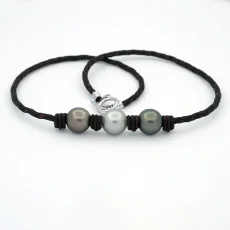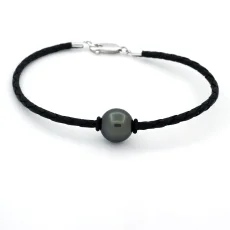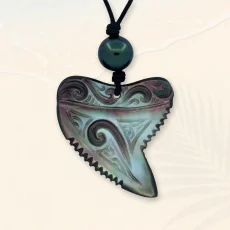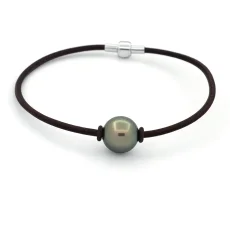


A genuine Tahitian cultured pearl is not recognized solely by its black color or its shine. Its origin, production method, and the absence of color treatment are essential criteria.
Based in French Polynesia, I want to explain what distinguishes our pearls from imitations and other black pearls sold worldwide. Here, the production and marketing of pearls are regulated by specific legislation.
1. A precisely defined origin
The Tahitian cultured pearl is produced in French Polynesia, mainly in the lagoons of the Tuamotu and Gambier archipelagos, by grafting the pearl oyster Pinctada margaritifera, variety cumingii.
Grafting involves inserting a small nucleus, called a nucleus, accompanied by a graft into the oyster. The oyster gradually deposits layers of nacre around the nucleus to form the pearl.
The local law n° 2017-16 of July 18, 2017 defines the Tahitian cultured pearl by its Polynesian origin, production method, and natural color.
This is an important distinction: pearls from the same oyster species can be cultured in other Pacific regions. However, they do not meet the local definition of the Tahitian cultured pearl.
2. A natural color, without dyeing
Contrary to what the expression “black pearl” suggests, Tahitian pearls are not all black. Their natural colors can be gray, silver, green, bluish, golden, aubergine, or peacock, sometimes with several reflections on the same pearl.
Polynesian regulations distinguish untreated Tahitian cultured pearls from pearl products that have undergone certain treatments. An artificially colored pearl cannot be presented as an untreated Tahitian cultured pearl under this regulation.
However, be careful: a very regular color is not necessarily suspicious, and a beautiful iridescence does not prove authenticity. Some freshwater pearls can also be dyed to resemble Tahitian pearls.
3. Luster, surface, and quality
Luster corresponds to the quality of light reflection on the nacre. The sharper the reflections, the higher the luster is generally considered.
A genuine pearl may show small marks, circles, or irregularities. These features are common, but their presence alone does not prove authenticity.
In French Polynesia, traditional classification notably distinguishes qualities Top Gem, A, B, C, and D, according to surface condition and luster.
A pearl of quality A or Top Gem shows very few visible defects. A pearl of quality C or D may have more marks while maintaining a beautiful color and interesting luster.
It is therefore important to distinguish the authenticity of a pearl from its commercial quality: a pearl with defects can be perfectly authentic.
4. Regulation in French Polynesia
The production and marketing of pearls are notably regulated by the local law n° 2017-16 of July 18, 2017 and its implementing texts, in their current versions.
This regulation defines pearl products, organizes professional activities, provides reporting obligations, and regulates controls as well as exports.
Pearl products intended for professional export are subject to formalities provided by Polynesian authorities, notably with the service in charge of pearl farming. Procedures vary depending on the nature of the products and the operation performed.
These local rules are not necessarily the same as those applied in other producing countries or foreign markets. That is why two sellers located in different countries may use descriptions or commercial classifications that do not exactly correspond to the same references.
5. The certificate of authenticity: what does it guarantee?
A certificate of authenticity issued by the seller specifies the declared characteristics of the pearl: nature, declared origin, size, shape, color, and quality.
However, this commercial certificate should be distinguished from an independent gemological analysis report.
Specialized laboratories, such as the GIA (Gemological Institute of America), can examine pearls using X-rays and other techniques to determine their nature, identify certain treatments, and study their internal structure.
A GIA report is not automatically provided with every Tahitian pearl and is not a general obligation for their sale. Moreover, identifying a pearl oyster does not necessarily prove the exact lagoon or country where the pearl was cultured.
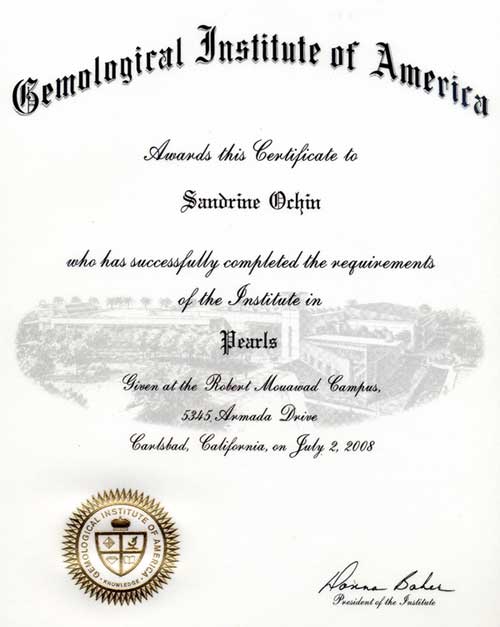
I personally completed the GIA Graduate Pearls training, dedicated to the knowledge, identification, and evaluation of pearls. This training allows me to apply recognized gemological criteria to select the pearls I offer you and explain their characteristics.
This training is distinct from an analysis performed by the GIA laboratory: it does not mean that every pearl sold by Taaroa Bijoux has been individually examined or certified by this organization.
To buy with confidence, I therefore advise you to verify the declared origin, the pearl description, the seller’s guarantees, and any accompanying documents.
6. My GIA Graduate Pearls training
To deepen my knowledge and better advise my clients, I completed the Graduate Pearls training from the Gemological Institute of America (GIA), an internationally recognized institute in gemology.
This training covers different natural and cultured pearls: Tahitian, Australian, Akoya, and freshwater pearls. It addresses their formation, characteristics, cultivation methods, treatments, and imitations.
GIA teaches an evaluation method based on seven quality criteria:
Size: the diameter or dimensions of the pearl.
Shape: round, semi-round, drop, baroque, or circled.
Color: the dominant hue and any secondary reflections.
Luster: the intensity and sharpness of light reflected by the nacre.
Surface: the presence, number, and visibility of imperfections.
Nacre quality: its appearance and characteristics allowing evaluation of its formation.
Harmony: the correspondence between several pearls, notably for earrings, bracelets, and necklaces.
This approach complements the classification traditionally used in French Polynesia. It allows me to appreciate a pearl as a whole, without limiting myself to its diameter or commercial category.
Practically, this training helps me select my pearls, evaluate their qualities, and explain why two pearls of the same size can have significant price differences.
It also enables me to better recognize the characteristics of different pearl families and understand the limits of visual examinations when verifying their authenticity.
7. Can a real pearl be recognized with the naked eye?
Some clues can help, but no simple visual test alone guarantees that it is a genuine Tahitian cultured pearl.
Color: it must correspond to that announced by the seller. Natural reflections may vary depending on lighting.
Surface: examine marks, circles, and possible defects, without assuming that a perfectly smooth pearl is necessarily fake.
Luster: observe the sharpness of reflections under soft light.
Drilling: on a drilled pearl, careful examination can sometimes reveal a nacre layer or traces of treatment, but this check remains limited.
Seller: favor a professional able to specify the origin, nature, and characteristics of the product.
I discourage tests that involve rubbing pearls on teeth, scratching them, or using chemicals. They do not determine geographic origin and can damage their surface.
8. Buying a genuine Tahitian pearl
An authentic pearl is not necessarily round, very dark, or expensive. Its value depends on several criteria: diameter, shape, luster, surface quality, color, and rarity of its characteristics.
My advice is to first choose a pearl you like, then precisely check its characteristics. A beautiful circled or baroque pearl can be just as interesting as a round pearl, often at a more accessible price.
At Taaroa Bijoux, I primarily want you to know what you are buying, with a clear description and useful information to make your choice. My GIA training and experience with Tahitian pearls allow me to support you in this process.
In summary
A genuine Tahitian cultured pearl is distinguished by its Polynesian origin, production in the oyster Pinctada margaritifera variety cumingii, and its natural untreated color, according to its local definition.
Neither color, luster, nor small imperfections alone certify its authenticity. Provenance, seller transparency, and if necessary, a gemological analysis remain the best ways to verify what you are buying.
Thanks to my GIA Graduate Pearls training, I can also provide you with precise explanations on quality criteria and help you choose a pearl with full knowledge.