


Glossary of Pearls farming & Lexic about Tahitian Pearls
The pearls farming uses a certain number of technical terms of which it is wise to know the significance before being plunged in this universe.
Here key words of the language of the pearls farming:
Aragonite: Carbonate calcium (CaCO3) entering the composition of the mollusc shells , and essential matter composing the pearls.
Collector: Artificial process (tree trunks, faggots of miki miki, lattice, nettings, etc.) allowing to fix the larvae swimmer of mother-of-pearl, the seed oysters.
Conchyoline: Organic matter that one finds in small quantity in the pearl (approximately 5%), being used as screen with the crystals of aragonite.
Détrocage: Action to separate young mother-of-pearl which tends to be bound in the greatest disorder on the collectors. Separated once, each mother-of-pearl is cleaned, then bored for then being suspended at an underwater station, while waiting for that it has the size to be grafted.
Fare graft: Small building which each farm has, often on pile, where the grafter operate mother-of-pearl.
Farm: Terrestrial and underwater installations allowing to produce pearls of culture. One speaks readily "farms" but pearls producers rather than about "farmers".
Graft: Operation carried out by the man and consisting in introducing into the gonad of a mother-of-pearl, a nucleus and a graft, in order to make him manufacture a pearl. A grafter approximately operates 300 to 600 mother-of-pearl per day.
Greffon: Fragment of the coat of a mother-of-pearl which one slips into the gonad of mother-of-pearl that one grafts, at the same time as the nucleus. This graft "will take root" in the gonad and will create the pearl-bearing bag.
Keishi: In some kind a "missed pearl", since it happens that grafted mother-of-pearl rejects the nucleus and in its gonad only the small graft preserves. This one, without form specifies well defined, starts the manufacturing process of the aragonite; mother-of-pearl then manufactures a natural pearl of very variable form and without core.
Luster: Indicate the brightness, on its surface, of a pearl subjected to a direct light; not to confuse with the East, more "interior".
Mabé: Half-pearl obtained starting from a core posed on the interior of a mother-of-pearl, under the "coat" of the animal.
Mantel: In a mollusc, folds of skin covering the visceral mass, and which secretes the shell of the animal, without adhering to it.
Seed Oysters: Larvae swimmer of bivalves (oysters, mother-of-pearl, moulds) before their fixing. By extension the word seed oyster indicates the small mother-of-pearl fixed on collectors, after the larvae finished their benthic life and clung to a support.
Nucleus: Small pearl manufactured starting from the shell of an alive bivalvular mollusc in water of the Mississippi. It is him which is introduced into mother-of-pearl at the time of the Clerc's Office, with the "graft".
Orient: Play of light on a pearl, which can vary according to the way in which the layers of aragonite settled around the core of the pearl. Certain pearls have the weak East (it are rather matt), others on the contrary have the very dense East, because the light seems to play in-depth in the surface layers of the pearl.
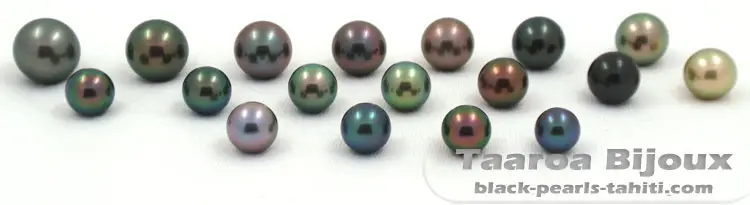
Pearl: Generally round, brilliant concretion and lasts, made of mother-of-pearl, being agglomerated in successive and concentric layers around a foreign body in a certain number of fresh water or sea water molluscs.
Pearl-bearing bag: Pocket created by the graft, inside the gonad, into which one introduces the nucleus.
Station: Underwater installations established in the lagoon, between surface and the funds, where mother-of-pearl intended for the Clerc's Office or already grafted grows.
Double-graft: Operation consisting in collecting a pearl produced after a first graft by a mother-of-pearl, and immediately reintroducing in the pearl-bearing bag a nucleus larger than the first, to make him manufacture one second pearl of large diameter.
Here key words of the language of the pearls farming:
Aragonite: Carbonate calcium (CaCO3) entering the composition of the mollusc shells , and essential matter composing the pearls.
Collector: Artificial process (tree trunks, faggots of miki miki, lattice, nettings, etc.) allowing to fix the larvae swimmer of mother-of-pearl, the seed oysters.
Conchyoline: Organic matter that one finds in small quantity in the pearl (approximately 5%), being used as screen with the crystals of aragonite.
Détrocage: Action to separate young mother-of-pearl which tends to be bound in the greatest disorder on the collectors. Separated once, each mother-of-pearl is cleaned, then bored for then being suspended at an underwater station, while waiting for that it has the size to be grafted.
Fare graft: Small building which each farm has, often on pile, where the grafter operate mother-of-pearl.
Farm: Terrestrial and underwater installations allowing to produce pearls of culture. One speaks readily "farms" but pearls producers rather than about "farmers".
Graft: Operation carried out by the man and consisting in introducing into the gonad of a mother-of-pearl, a nucleus and a graft, in order to make him manufacture a pearl. A grafter approximately operates 300 to 600 mother-of-pearl per day.
Greffon: Fragment of the coat of a mother-of-pearl which one slips into the gonad of mother-of-pearl that one grafts, at the same time as the nucleus. This graft "will take root" in the gonad and will create the pearl-bearing bag.
Keishi: In some kind a "missed pearl", since it happens that grafted mother-of-pearl rejects the nucleus and in its gonad only the small graft preserves. This one, without form specifies well defined, starts the manufacturing process of the aragonite; mother-of-pearl then manufactures a natural pearl of very variable form and without core.
Luster: Indicate the brightness, on its surface, of a pearl subjected to a direct light; not to confuse with the East, more "interior".
Mabé: Half-pearl obtained starting from a core posed on the interior of a mother-of-pearl, under the "coat" of the animal.
Mantel: In a mollusc, folds of skin covering the visceral mass, and which secretes the shell of the animal, without adhering to it.
Seed Oysters: Larvae swimmer of bivalves (oysters, mother-of-pearl, moulds) before their fixing. By extension the word seed oyster indicates the small mother-of-pearl fixed on collectors, after the larvae finished their benthic life and clung to a support.
Nucleus: Small pearl manufactured starting from the shell of an alive bivalvular mollusc in water of the Mississippi. It is him which is introduced into mother-of-pearl at the time of the Clerc's Office, with the "graft".
Orient: Play of light on a pearl, which can vary according to the way in which the layers of aragonite settled around the core of the pearl. Certain pearls have the weak East (it are rather matt), others on the contrary have the very dense East, because the light seems to play in-depth in the surface layers of the pearl.
Pearl: Generally round, brilliant concretion and lasts, made of mother-of-pearl, being agglomerated in successive and concentric layers around a foreign body in a certain number of fresh water or sea water molluscs.
Pearl-bearing bag: Pocket created by the graft, inside the gonad, into which one introduces the nucleus.
Station: Underwater installations established in the lagoon, between surface and the funds, where mother-of-pearl intended for the Clerc's Office or already grafted grows.
Double-graft: Operation consisting in collecting a pearl produced after a first graft by a mother-of-pearl, and immediately reintroducing in the pearl-bearing bag a nucleus larger than the first, to make him manufacture one second pearl of large diameter.